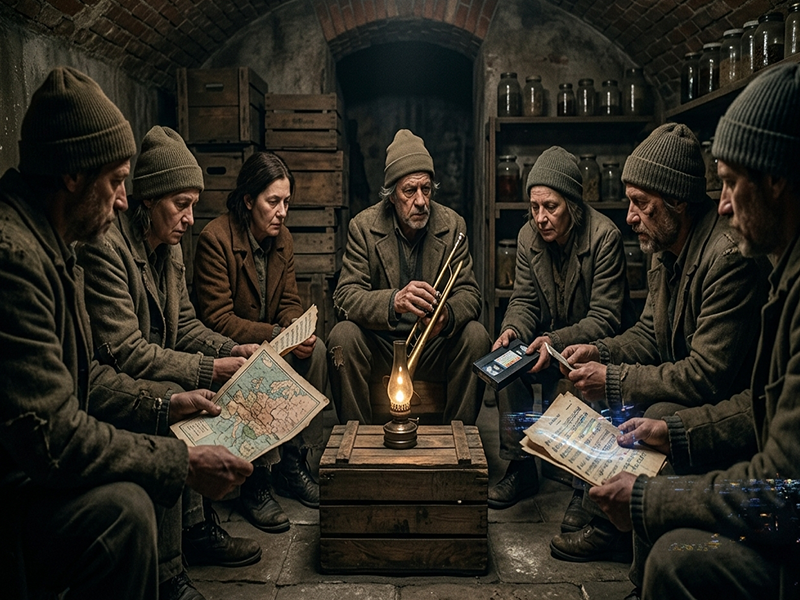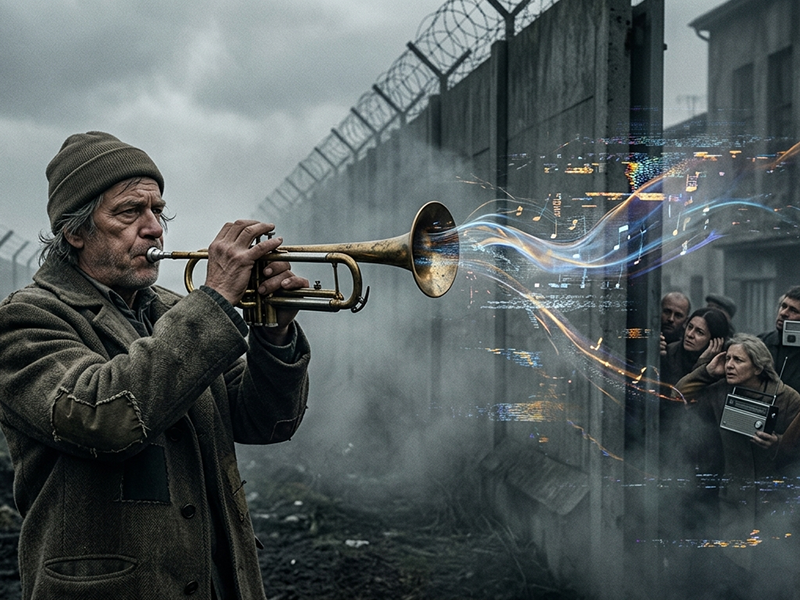
In one of the quietest scenes in The Static and the Silence, a seventeen-year-old boy named Ardian Kodra kneels over a broken radio in his family’s attic. It is late. The house is asleep. The country is asleep. He turns the dial and hears the long, familiar ocean of white noise that he has heard a thousand times before. Then something cuts through it. A trumpet. Warm, bright, and absolutely impossible.
It is a small moment. A boy. A wire. A note. And yet, in the world Norberto Mazzi writes about, that single sound carried more weight than most readers in the West will ever fully grasp.
What Albania Sounded Like in The Late 1970s
To understand why, it helps to remember what Albania was during the years the book is set in. By the late 1970s, the country had cut itself off from almost every neighbor it had. Borders were sealed. Radios were registered. Television was rationed to State channels. The music that filled the schools, the factories, and the public squares was approved music, written to serve the State and to flatten anything that resembled private feeling. Songs of personal longing were suspect. Songs of love that did not also love the Party were suspect. Anything that arrived from abroad, on a smuggled cassette or a stray broadcast from across the Adriatic, was treated as a threat to the national soul.
This is the world that Ardian’s trumpet enters.
What A Single Song Can Open Inside A Person
Mazzi writes the moment carefully. The boy does not understand jazz. He has no language for what he is hearing. He simply feels something open inside his chest that nothing in his official life has ever opened before. The melody bends, slides, and refuses to march in a straight line. For a boy raised on rigid anthems and didactic folk songs, that refusal is the first revelation. Music is allowed to do this. Music is allowed to feel like longing, like hope, like flight.
Why the Regime Feared Music More Than Slogans
The regime understood the danger of this kind of music far better than most cultures ever do. It understood that a song does not argue. A song does not lecture. A song slips past the rational mind and lodges itself somewhere older. By the time a person notices what has happened, the song has already changed the shape of their inner life. That is why Western jazz, blues, and rock were not banned in Albania for being noisy. They were banned for being free.
The Double Life of a Young Listener
What Mazzi captures in this scene, and in the chapters that follow, is the strange double life that such a moment forces on a young listener. On the surface, Ardian’s days look exactly as they did the morning before. He puts on the same clothes. He walks the same route to school. He sits through the same lessons. But inside, a frequency has changed. He hears the official songs differently now. He notices the silence in his own home. He notices the careful way his father reads the paper. He starts to understand that the world he grew up in is not the only world that has ever existed.
Listening as The First Act of Defiance
That is the trumpet’s real work. It does not save him. It does not arm him. It does not give him a plan. It simply tells him the truth that the State has spent his whole life trying to hide. The truth that there is more out there. More sound. More feeling. More ways to be a person.
The rest of the novella is, in many ways, the slow consequence of that one note. The friends he meets, the risks he takes, the rooftop he eventually climbs with a homemade transmitter, all of it begins in the attic with a piece of borrowed light slipping through a closed sky.
This is why Mazzi keeps returning, in his work, to the relationship between sound and freedom. Some of the bravest acts in history were not loud. Some of them were small enough to fit between the static and the next station on the dial.